
StoryTerra’s New Chapter: Building a Bridge Between Fiction and History
The journey continues. I’ve added the real history that inspired our favorite stories to the map. Here’s how it transforms exploration.
StoryTerra started as a platform where users could explore stories (books, movies, games, and shows) on an interactive map by location and time. But stories don’t exist in a vacuum. They’re shaped by the world in which they take place.
While you’re lost in a novel set in 1880s London, what was happening on those same streets? When you’re playing a game set during the American Revolution, what other world-shaping events were unfolding at that very moment, across the ocean?
With this update, we go deeper: now you can explore real-world history side-by-side with fictional narratives.
A New Layer of Reality: The History Tab
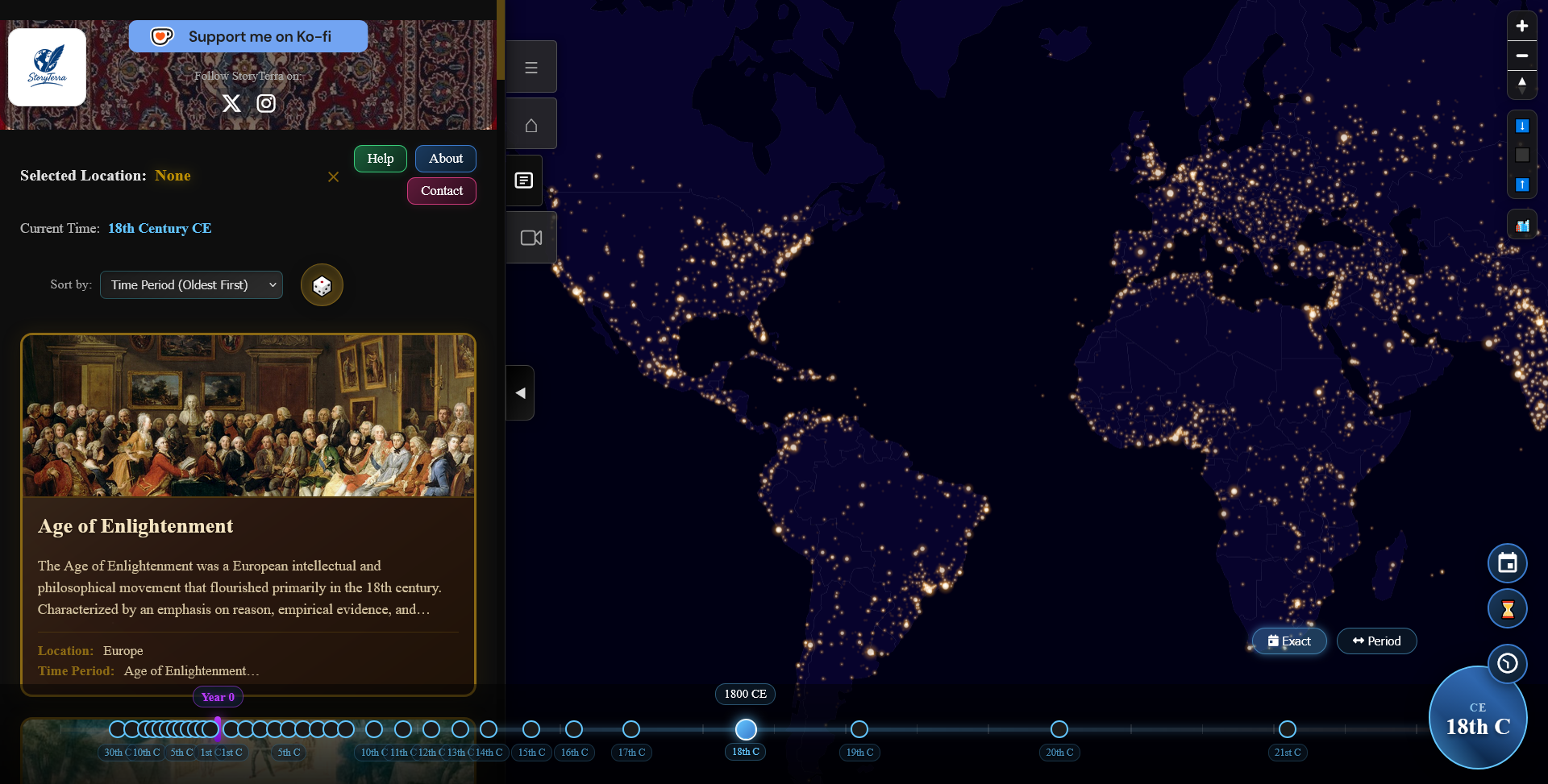
History Tab view, listing Historical Eras/Events happening in 18th century
The History Tab works just like the Home Tab (Where you explore stories)— you can set a time period and select a location on the map, and see what real historical events or eras were unfolding in that time and place. These aren’t limited to one country or region, the content spans all over the globe, including ancient civilizations, major revolutions, golden ages, and transformative moments in city histories.
Key Differences Between the History Tab and Home Tab
The filtering behavior between stories and history items differs in a key way:
- In the Home Tab (stories): Selecting a city like London shows only items that take place in London specifically, not the whole UK.
- In the History Tab: If an event is tagged with a country (like France), it will show up when you select Paris or Lyon. This is to reflect how cities inherit the historical weight of their broader national contexts.
This makes it easier to explore layered historical content without missing key events.
What’s Inside a History Card?
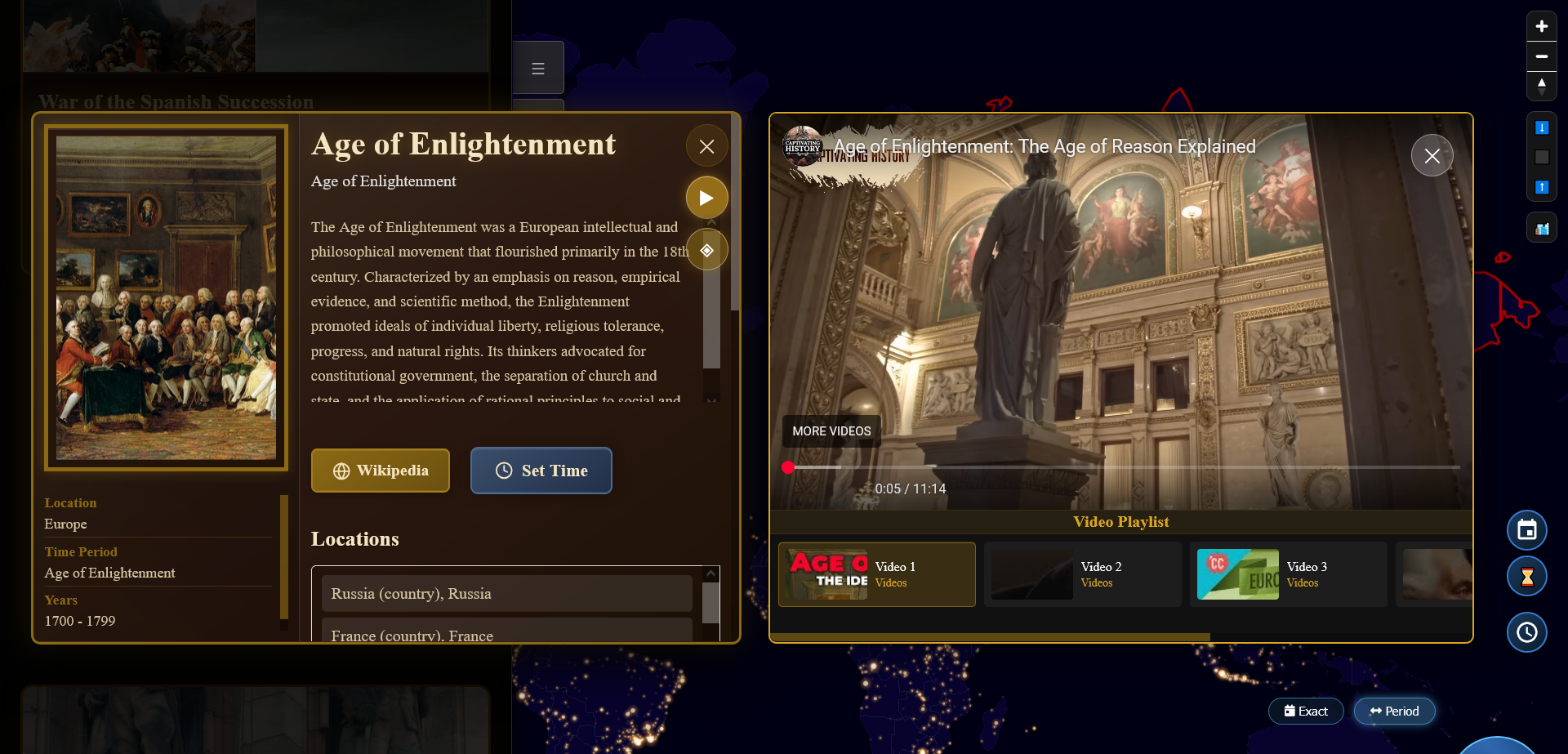
An opened History Card, with the media player opened on the right side.
Each History Card is crafted to give you both depth and usability:
- Wikipedia Summary + Link : The core data is sourced from Wikipedia, then curated to match StoryTerra’s internal location database.
- Time Period & Location Matching : Each event or era is tagged with time frames and mapped precisely to countries or cities.
- Documentary Videos : Every history card comes with YouTube documentaries embedded directly in the card. On desktop, click the Media button (top-right of the card) to open the full media player for a more immersive viewing experience.
- Similar Stories Button: Find stories that either relate directly to the history event/era, or share key themes. This feature is now available on every story card across the platform.
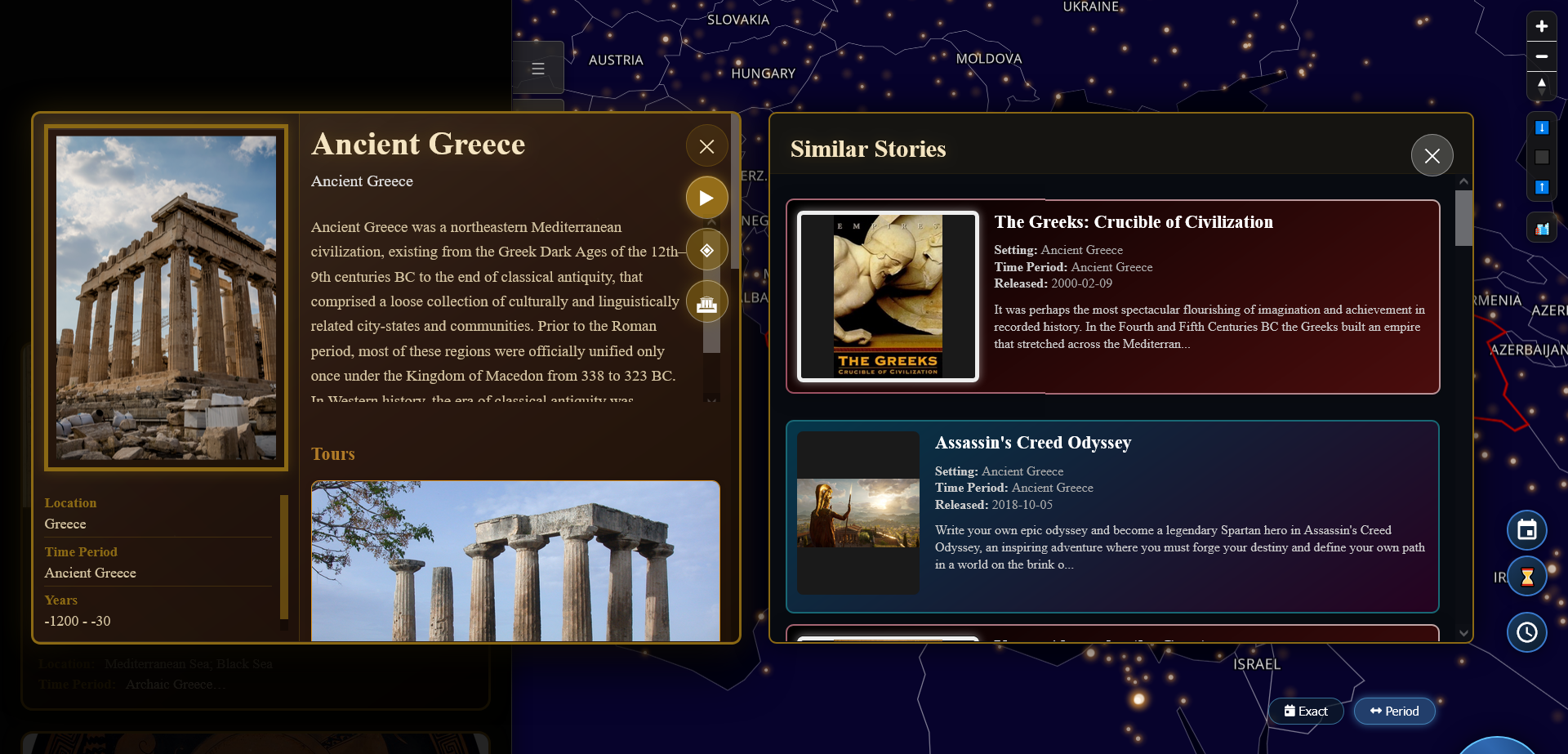
Similar Stories tab, listing stories related to Ancient Greece
- Set Time Button: Clicking this sets the global time of StoryTerra to match the time period of the event, allowing seamless exploration.
- History Button — This opens one of the most powerful new tools…
The Intersection: The New History Panel
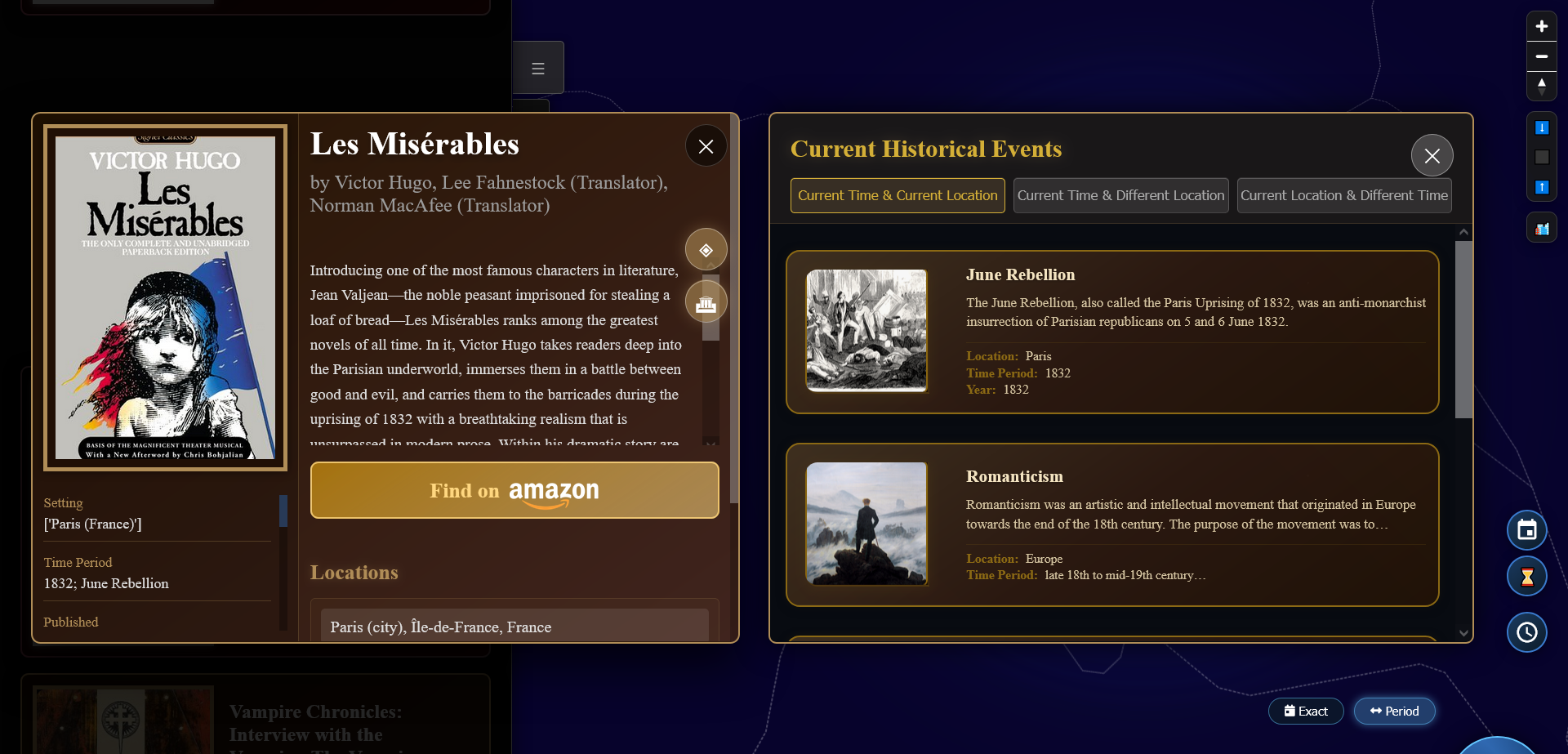
June Rebellion unfolding in the same time as Les Misérables in pairs
Whether you’re looking at a story (a movie, game, book) or a history card, you’ll now see a “History” button that opens the History Panel. It’s a dedicated space to explore the intersection of that specific item and real-world history, filtered in three distinct ways:
Current Time & Current Location
For example, if you’re exploring Les Misérables, set in 1832 Paris, you’ll discover the June Rebellion unfolding in the same streets at the same time.
Current Time & Different Location
Curious about what was happening elsewhere during the same time? This filter lets you look for current historical events/eras across the globe. For our Les Misérables example, while the June Rebellion was unfolding in Paris, the United States was in the midst of the Nullification Crisis. See what else was happening in the world at a glance.
Same Location & Different Time
This allows you to see the long history of the locations of this story. Explore the events that happened long before this story began and those that came long after, all in the same location.
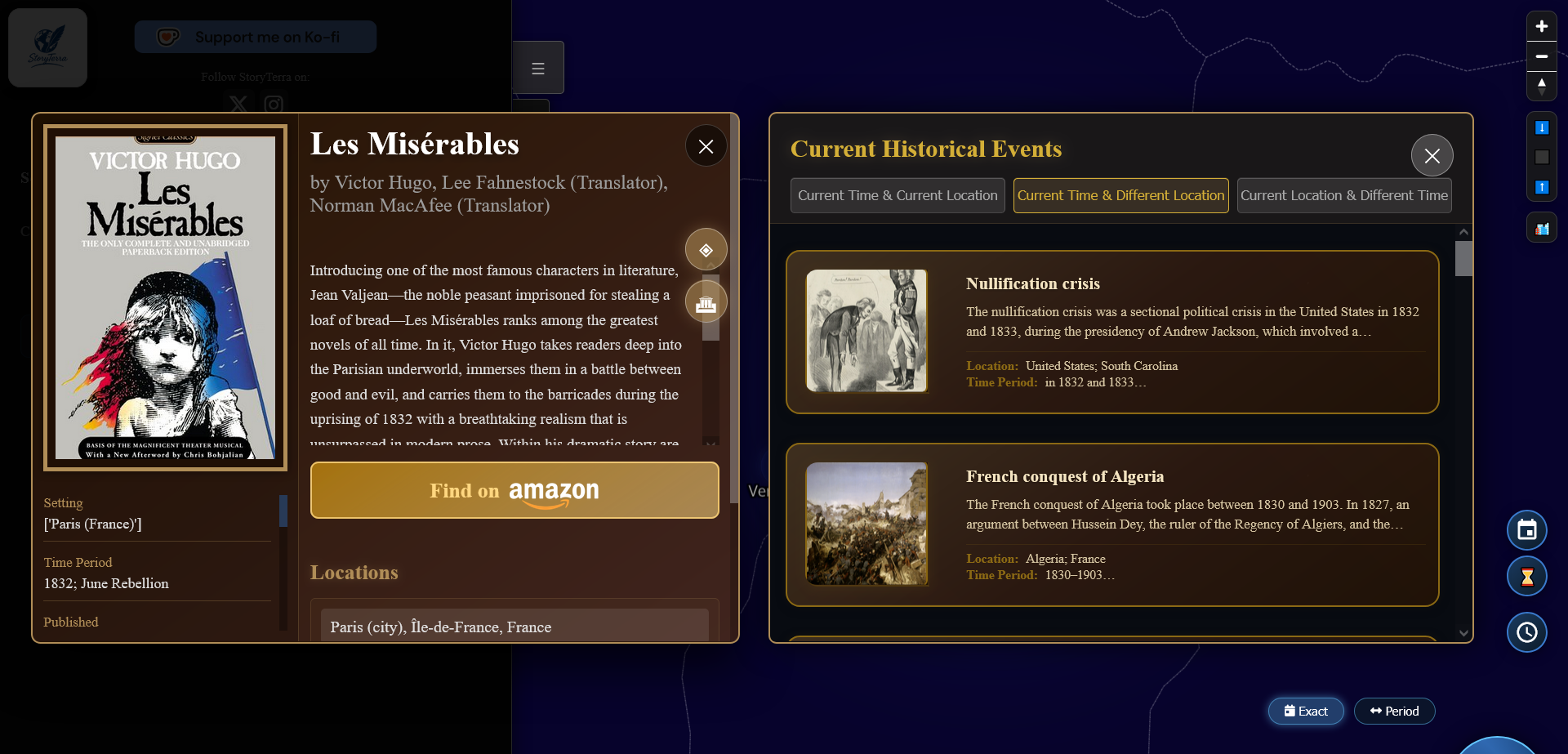
While the June Rebellion was unfolding in Paris, the United States was in the midst of the Nullification Crisis.
The New Bookmarks Tab
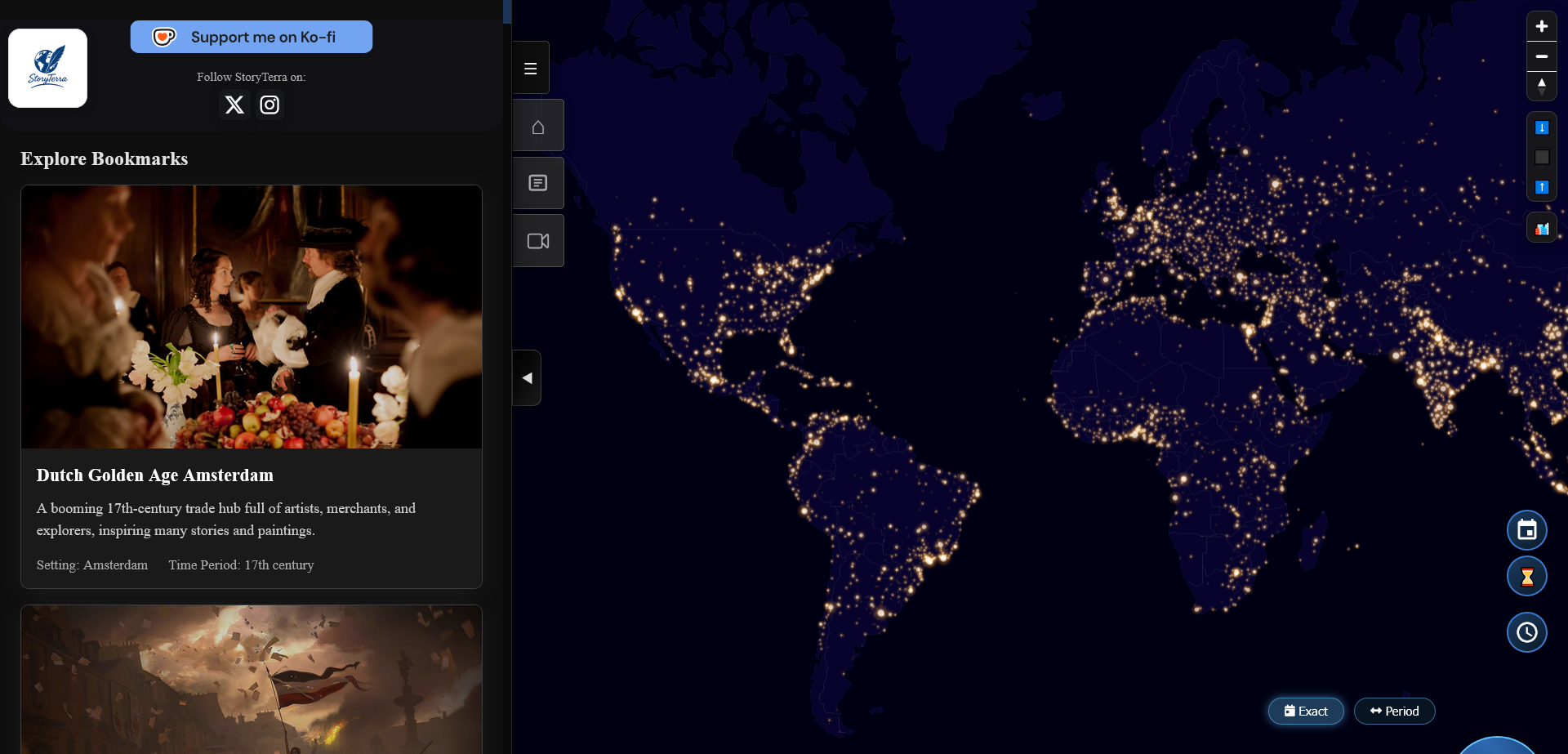
Bookmark Tab is the front page of StoryTerra, giving you presets of interesting Time&Location combinations
The Bookmarks Tab is now StoryTerra’s new front page. Each bookmark is a preset cultural moment, from Victorian London to Ancient Egypt to Amsterdam’s Golden Age and much more!
Clicking a bookmark:
- Automatically sets the global time to that era
- Selects the relevant location
- Displays both stories and historical events for that time and place, you can switch between story and history views as you explore.
You are of course free to keep exploring other locations and change the time as you want!
Bonus: Tours for the Real World
Some stories and historical events now include a “Tours” section, highlighting real-world places you can visit that are directly connected to the narrative or historical moment.
Planning a trip? StoryTerra can now give you story-driven travel inspiration. More curated tours are coming soon.
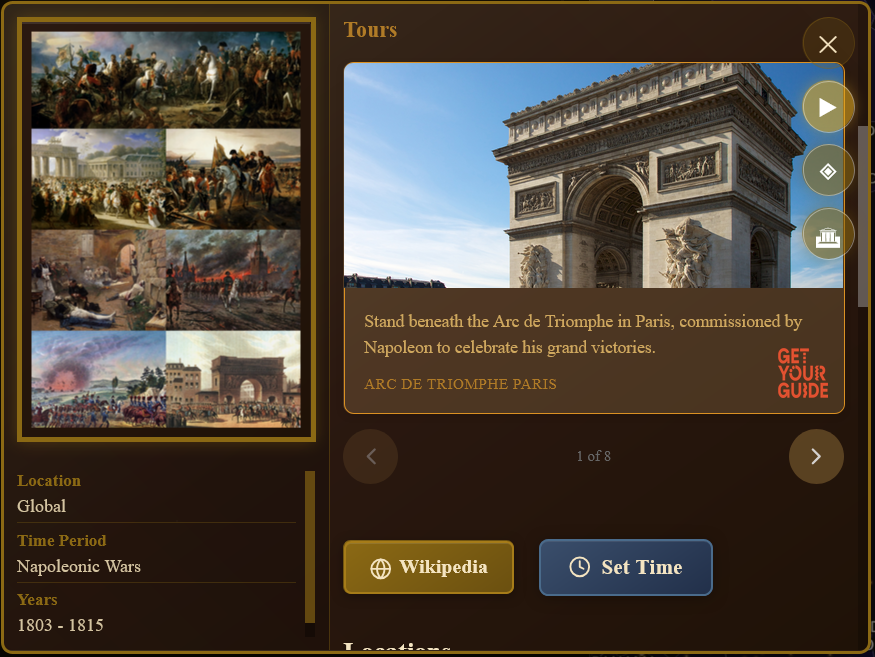
Example of a “Tours” section in a historical card — highlighting real-world locations you can visit related to the Napoleonic Wars, such as Waterloo Battlefield in Belgium and Les Invalides in Paris (where Napoleon’s tomb resides).
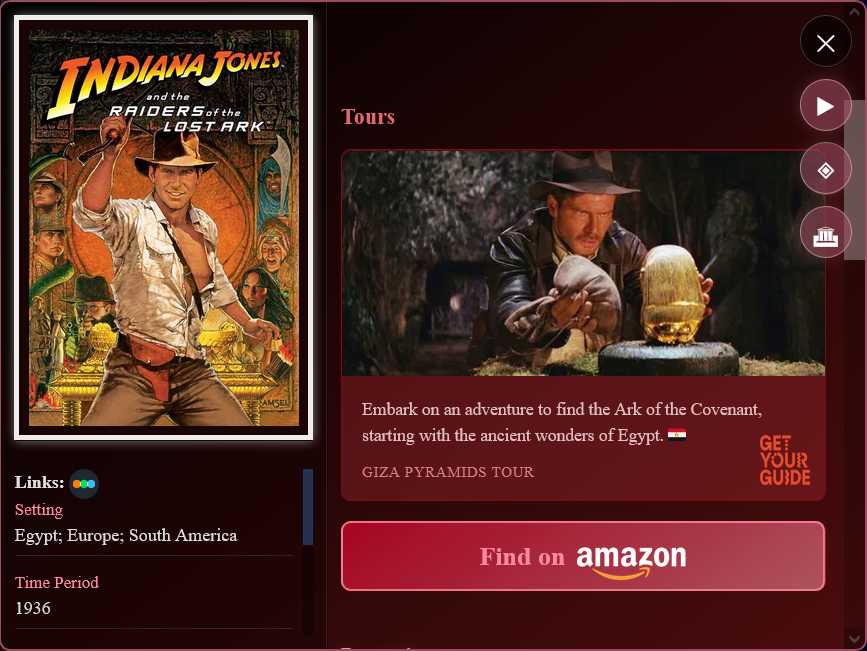
“Tours” section shown in a story card for Raiders of the Lost Ark , featuring travel location of the Giza Pyramids in Egypt.
What This Update Changes for StoryTerra
This update adds a layer of real history to the platform.
Before, StoryTerra was focused on fiction , books, movies, games, mapped by location and time. Now, users can explore historical events and eras in the same way.
The structure of the platform hasn’t changed, but what you can do with it has. History cards function just like story items, with filters for time and place, but they introduce new context. You can now see what was actually happening in the same location and period as a fictional story, with a simple tab switch.
This update was a massive undertaking, but it feels like the logical and necessary evolution of what I set out to build. It’s also just version one , there may be gaps or missing details here and there, but the foundation is in place. More history items will be added over time, and the system will keep improving with future updates.
StoryTerra is no longer just a map of fiction; it’s a map of the dialogue between fiction and history.